Learning games: Not just for the kids!

A person sitting at a desk with a computer

Description automatically generated
Learning games in primary school are now standard practice. DSC04520 by Laurie Sullivan in Flickr (CC by 2.0)

Until very recently, I’d always thought of video games as something for kids and teenagers – not something that busy adults would waste their time doing. However, that was until I discovered Yousician.

For as long as I could remember, I’ve wanted to be able to play the keyboard. So twelve months ago, I decided to tick off some items on my bucket list – and learning keyboard was write up there at the top of the list.

The barriers to learning previously had always been the time and cost of lessons; the answer to overcoming those barriers was Yousician – a music lesson app which uses game elements to reward and engage ‘players’ into learning their chosen instrument.

Learning a musical instrument is fun with digital technology. Image: Old music, new music sheets by Mikael Wiman in Flickr (CC by NC-ND 2.0)

For the keyboard, the app shows you which fingers to press on which keys and the timing at which to do so. It then ‘listens’ to you playing your instrument and provides a score and a number of ‘gold stars’, which determines whether you can move to the next song, or whether you need to repeat the song with the gentle instruction of:

‘Let’s see if you can do better than that’.

As someone interested in education design, I found that it uses many of the standard gamification techniques to motivate and engage the users through the learning path. These included progression towards a goal, reward for achievement, competition and public recognition. Essentially, the app uses gamification ‘to re-frame a real-life goal to be more appealing and achievable’ by using elements from traditional gameplay (Denmeade 2017, p. 155).

The first digital learning games were introduced with Where in the World is Carmen Saniago by the Learning Company in 1985 (Haughton Mifflin Harcourt 2020 https://www.carmensandiego.com/).

Now, digital game platforms to achieve learning goals within primary school and secondary school environments are fairly well-established learning tools. Some examples used in Australian classroom that teachers, parents and students will all be familiar with are Reading Eggs in primary school and Mathletics in primary and secondary school.

A brief run-down of the key elements in classroom gamification and the possibilities are discussed in a special video edition, Edu-trends below:

As a first-time adult user of a gamified digital educational environment, the most important revelations for me was how fun, convenient and addictive this style of learning could be.

Then as someone working in vocational education, I started wondering how I could transfer that level of engagement that Yousician induced into the vocational classroom.

The students who have been regularly learning through digital games are now well and truly grown up. The 10-year-olds in 2012 who were using Minecraft to build and design are now 18-year-olds, some of whom are entering vocational education.

However in adult learning, particularly in the trades, learning through fun, interactive and engaging games is pretty rare. This is despite adults gloablly spending three billion hours a week playing video games outside of work and school (Klopfer, Osterweil, and Salen 2009).

Unfortunately for them, once they enter TAFE their digital learning skills are not generally continued with many vocational classrooms taking them backwards in relation to their use of digital games as educational tools. Where they have been learning on Duolingo in high school, they get into TAFE and it’s back to 1990 and a teacher at a whiteboard talking at them. It is not surprising that drop-out rates are so high; Victoria’s TAFE students the least likely to finish with just 29.6% completing their qualifications (Carey, 2019).

Box Hill Institute’s welding department is one example of a trade training organisation using gamification tools to teach trades. Within the welding department are augmented reality welding machines which allow students to practice welding before they move onto the real equipment. The software associated with this technology includes gamified elements to the learning, such as scoring and leaderboards. You can see more about this technology in my previous blog and podcast on this topic:

A picture containing text

Description automatically generated

Edu-Trends podcast Episode 1: Augment Reality, Image:by Julie Athanasiou created in Canva, All Rights Reserved.

So, what are some of the other options for using gamification in the vocational education space.

Based on the work of the Massachusetts Institute of Technology in Moving Learning Games Forward, I’d like to make some suggestions as to how various digital gamification platforms could be used in TAFEs today:

  • Authoring Platforms: An authoring system is a program that has pre-programmed elements for creating something digitally. So, for example, within the TAFE space this could be students using platforms like Starcraft to create a model in cabinet-making.
  • Content Systems: These are games that deliver content about a particular topic. A challenge for trades teachers in including games in the classroom has been the lack of game-content specific to the various trades. However, this challenge can be overcome with the proliferation of relatively cheap and user-friendly game-authoring software which teachers can download to create their own games for their specific curriculum.
  • Game authoring programs for students: Students can use authoring programs to design games, and in the process they research and learn about a subject. They then share the game with their classmates to continue the learning for others. For example, in the TAFE space, auto-mechanic students could make games in a game authoring platform like Rezzly about diagnosing a mechanical problem and the right tools to choose to fix that problem
  • Documentary: While not ‘games authoring’ software, documentary software can contain gamified elements which are motivating and rewarding to students. By challenging students to document activities or asking them to create ‘how-to’ videos for the various trades weaves gamification-elements into the activity.
  • Simulations: Simulations like Minecraft and Bridge Builder are existing programs which allow students to test theories in engineering in a virtual environment and are relevant to several of the trade areas (Klopfer, Osterweil and Salen, 2009).

As with any pedagogy approach, there is a continuum which can be applied. So, at the low-tech level would be including board games or other face-to-face games in the classroom. The next technological level, might be creating flash-cards and quizzes which students can access and answer on devices.

Gamifying trade education can seem like a big leap from where it is currently. But experiencing the fun of a gamified learning by downloading a learning app on a topic of interest, like I did with Yousician, is a starting point to experience the level of engagement possible and to provide inspiration on how the gamified learning approach can be transferred to your particular field.

References:

Carey, A 2019, ‘Victoria’s TAFE course completion rate the worst in Australia’ The Age, accessed 6 February 2020 at https://www.theage.com.au/national/victoria/victoria-s-tafe-course-completion-rate-the-worst-in-australia-20190829-p52m5l.html

Denmeade, N 2017, ‘The hero’s learning journey’, World Journal of Science, Technology and Sustainable Development, vol. 14, no. 2/3, pp. 155–171, viewed 31 January 2020, http://search.ebscohost.com/login.aspx?direct=true&db=edsemr&AN=edsemr.10.1108.WJSTSD.06.2016.0042&authtype=sso&custid=deakin&site=eds-live&scope=site

Haughton Mifflin Harcourt, The Learning Company 2020, accessed 6 February at https://www.carmensandiego.com/

Interactive Games and Entertainment Association 2018, Digital Australia 2018 Report, Accessed February 4 2020 at https://www.igea.net/wp-content/uploads/2017/07/Digital-Australia-2018-DA18-Final-1.pdf

Klopfer E, Osterweil, S, and Salen, K 2009, ‘Moving Learning Games Forward’, Massachusetts Institute of Technology, accessed February 6 2020 at https://education.mit.edu/wp-content/uploads/2018/10/MovingLearningGamesForward_EdArcade.pdf

Image references

Coverr-Free-Footage, ‘Unnamed Video’ downloaded and created in Canva 2 February 2020, video, Free Use License

EVG photos ‘Person Typing on Laptop’ downloaded and created in Canva 2 February 2020, video, Free Use License

gorodenkoff ‘Factory: Female Industrial Engineer Wearing Virtual Reality Headset and Holding Controllers’, Adobe-Stock, downloaded and created in Canva 2 February 2020, video, One Time Use License

KML ‘Unnamed Video’ downloaded and created in Canva, video, Free Use License

Konstantynov, ‘Woman Playing Game on Mobile Phone’, Dreamstime.com, video, downloaded and created in Canva 2 February 2020, One Time Use License

konstart ‘Two factory workers walking and discussion with tablet pc. Industrial background’, Adobe-Stock, downloaded and created in Canva 2 February 2020, video, One Time Use License

lalesh aldarwish ‘Gray Scale Image of xbox controller’ downloaded and created in Canva 2 February 2020, photograph, Free Use License

Nymburský , J, ‘Black Sony Ps4 Dualshock 4 Wireless Controller’ downloaded and created in Canva 2 February 2020, photograph, Free Use License

McInall, J Man Playing Game on Personal Computer, photograph, downloaded and created in Canva 2 February 2020, photograph, Free Use License

rexzillaz ‘Group of Happy and Positive Business People Celebrating’, iStock.com, downloaded and created in Canva 2 February 2020, video, One Time Use License

Greenscreen background

Athanasiou, J 2020, Edutrends logo created in Canva, All Rights Reserved

Stux, Chalkboard Texture Background downloaded and created in Canva, One-Time Use License

Podcast launch: From addict to creator

I’ve been a long-time podcast addict. It started with a pod-pusher introducing me to a gateway-listen — the true-crime podcast, Serial. Soon after, I couldn’t get enough of the popular This American Life. However, the addiction truly spiraled out of control when I discovered the more indie history delights like Lore and Rude Tudors.

Serial: a viral podcast that introduced many people
to the genre. (‘Serial Podcast‘ by Casey Feisler, CC by 2.0)

I now listen daily to a range of podcasts for entertainment, but the ones I find the most life-changing are the educational, particularly ones involving the world of work.

So, when I was given the task of creating my own podcast, I was immediately drawn to the topic of vocational education, and wanted to create a podcast TAFE teachers could use to improve student outcomes.

As a current MBA student at Deakin University, I’ve greatly valued the research available at the online library. However, I know most people don’t have access to these sorts of research facilities and also don’t have time to look through the latest research.

As such, the inspiration for the Edu-trends podcast was born — a weekly five-minute-ish pocket-listen about the latest trends and research in vocational education. It is designed to be a quick snippet that someone can listen to while walking to their next class and which may spark their interest in a particular new aspect of vocational training. I’ll also include show notes on where they can access more information to implement it in their workplace.

A new teaching technology which I recently came across is the augmented reality welding machines at Box Hill Institute produced by Soldamatic. I was given a demonstration of these machines so that I could write up an application for a ‘sustainability in education’ award. While we didn’t win the award, I was impressed with the possibilities of this technology for improving trade education and I also realised from discussion with peers that it was not something widely known about.

‘Soldamatic 2018 – New Features’, Seabery, YouTube

A quick search of the Deakin online library found some research into the topic, but also confirmed it was a topic that did not have an overly extensive amount of existing research particularly in the vocational sector. The most relevant article for the intended first Edu-trends podcast topic was by Akçayır & Akçayır (2017, p. 2) which was a systematic review of the literature in augmented reality in education. Using the articles in this literature review as a starting point and also my existing knowledge of the Soldamatic technology gave me enough information to base this first podcast.

You can listen to the result here: Edu-trends Episode 1: Augmented Reality in Trade Training.

Once I had the strategy, and the first topic, the most satisfying part of creating the podcast was the amount of free video and audio content that is available from other podcasters in the technological aspects of the craft. I reflect on that and provide what I think is a great supplementary resource to videos in my brief vlog on this topic:

My main point here is that it is an incredibly generous community where people are sharing their software, their technical knowledge and their music to allow other new podcasters to join in. So if you are a podcast addict or just someone new to the genre, finding your topic and then learning the ropes through free videos are the first steps to your own podcast creation.

References

Akçayır, M & Akçayır, G 2017, ‘Advantages and challenges associated with augmented reality for education: A systematic review of the literature’, Educational Research Review, vol. 20, pp. 1–11, viewed 13 January 2020

Seabury Ptd Ltd 2019, ‘SOLDAMATIC 2018 – New Features’, Seabury, Youtube, https://www.youtube.com/watch?v=mFO74WWoKbw, Accessed 29 January 2020

Title Image

Edu-Trends‘, Julie Athanasiou, created in Canva, CC by 2.0

Podcast Music

Take Me Higher‘ by Jazzhar, FreeMusic Archive, CC by 2.0.

Braced for negativity: When online help comes at a price

Online health communities, where patients with the same condition share experiences and advice, are generally interpreted by researchers as a positive outcome of the ‘online global village’ (Stadtelmann, Woratschek & Diederich, 2019).

My experience with these groups was not as the academics presented. I quit them soon after joining — and I don’t regret it.

The Diagnosis

Late last year, an appointment with a scoliosis clinic delivered some unexpected news to our family.

“Your daughter’s x-rays indicate Scheuermann’s Disease.”

We drove away from the appointment, trying to remember everything the doctor had said.

“It’s a rare condition…a spinal deformity…spinal brace 22 hours a day for two years and if that fails, a spine operation — which you want to avoid.”

Given the remembered snippets, I did what any modern-day mum would do — I went straight to Dr Google and read all I could on the condition.

Some of it was useful, but it lacked something — the personal experience of other people with the condition, or other parents who had children with the condition.

The ‘Family Stigma’

One of my first instincts after the initial appointment had been to post something on my Facebook page but I stopped myself as I knew this would be, as referred to by social media researchers, as an ‘intimate transgression of private information’ (Smith & Watson, 2013). My teenage daughter would not want this information shared in this forum — even if I would get positive reinforcement in the empathy it would elicit from others.

Also, the news of something happening to my child didn’t fit with my curated Facebook profile which documents and archives happy family moments; milestones, holidays and outings. Bad medical news would not fit there.

My instincts were right. Social media researchers have reported a ‘ family stigma’ in talking about a child’s disability or illness on social media (Ammari, Schoenebeck, and Morri, 2014).

Lauren's Spinal Brace by Julie Athanasiou
‘Lauren’s Spinal Brace’ by Julie Athanasiou, Dec. 13, 2020

When I had exhausted the medical-centred explanations and with a self-imposed ban on my family-centred Facebook page, I instead joined several private Facebook pages set up by people who had the condition. My main aim was to  learn from others how my daughter could manage to wear the prescribed brace.

The Scheuermann’s Disease-related Facebook sites’ privacy settings allowed for activities I wouldn’t do normally — I could ask questions, get real-life answers and be empathised with and give empathy to others without infringing on family and friends whose sympathy would feel too personal (Brady, Zhong, Morris and Bigham, 2013).

By splitting my Facebook presence between the public and the private, I could present myself as the mother of a child with a rare condition and ask questions to the people to whom it was relevant without attaching the ‘disease stigma’ to my public profile.

From Service Beneficiary to Service Provider

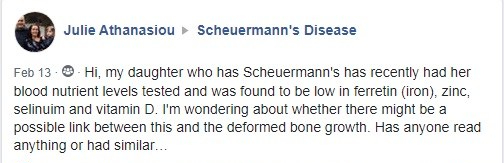
Initially, involvement in the groups was useful. I was what would be described by Stadtelmann et al. as a ‘service beneficiary’. I asked questions and the very helpful group members supplied useful answers (Stadtelmann, Woratschek and Diederich 2019) .

Facebook Post by Julie Athanasiou
‘Facebook Post’ by Julie Athanasiou, Feb. 13, 2018

After learning more about the condition through my daughter’s experience, I found myself moving into an alternate role of the ‘service provider’. In this role, I was able to provide advice to others on practical subjects to manage the brace-wearing like the best mattress, the best undershirt, the best exercises, and so forth.

I also found myself in the role of the ‘empathiser’ providing kind words and helpful advice to new group members. In a time of powerlessness, when I couldn’t control my own child’s health, I found strength and purpose in helping others.

However, the positives of private groups comes at a price — a deluge of the negative experiences from people who feel they have no where else to vent.

Logging off private going public

Overtime, membership to the group was not worth the daily feed of sadness.

In contrast to the academic studies on the positive nature of these communities to empower patients, I found the primary users tend to be the worst-case scenarios.

Each day there were multiple posts from members who wanted to know which oxy-type drug others used for pain or pleas for help with suicidal thoughts. The failings of the health care system forced them to reach out to the online world as they were not receiving the support and care they needed in real life.

Recently, and in contrast, I also started to notice that the public Twitter hashtags relating to the condition are different — positive stories of hope for those living with the condition. There were other ways to present the story.

Although my role as ‘expert’ and ‘empathiser’ in the private Facebook groups felt useful, I could no longer align my online presence with the actual real-life experience. With the initial diagnosis-crisis over, my daughter’s life wasn’t like the people posting about drug-recommendations and suicidal ideation.

My adaptable, forward-thinking daughter was out living her life; wearing her brace, excelling at school, hanging with friends and most importantly looking forward to the future. I checked out of the private online health groups and decided I’d follow her example instead.

Cover image: ‘Living Life Offline’ by Stacey Nikolitsis ©  (All Rights Reserved)

References:

Ammari, T, Schoenebeck, S, Ringel Morris, M (2014), Accessing Social Support and Overcoming Judgment on Social Media among Parents of Children with Special Needs, Preceedings of theEighth International AAAI Conference on Weblogs and Social Media, University of Michigan Available at: https://www.microsoft.com/en-us/research/wp-content/uploads/2016/02/ammari_ICWSM2014.pdf

Brady, E.L., Zhong, Y., Morris, M.R., and Bigham, J.P. (2013) Investigating the appropriateness of social network question asking as a resource for blind users. In Proc. CSCW 2013, ACM Press, 1225-1236. Available at: https://www.cs.cmu.edu/~jbigham/pubs/pdfs/2013/socialnetworkappropriateness.pdf

Smith, S and Watson, J (2013), ‘Virtually Me, A Toolbox about online self-presentation’, Identity technologies : constructing the self online, Wisconsin studies in autobiography, edited by Anna Poletti and Julie Rak, The University of Wisconsin Press, viewed 12 December 2019, Available at: http://search.ebscohost.com/login.aspx?direct=true&db=cat00097a&AN=deakin.b2962458&authtype=sso&custid=deakin&site=eds-live&scope=site.

Stadtelmann, M., Woratschek, H. and Diederich, C. (2019). Actor engagement in online health communities: A netnographic analysis of engagement practices and roles | Emerald Insight. [online] Emerald.com. Available at: https://www.emerald.com/insight/content/doi/10.1108/IJPHM-06-2018-0033/full/html [Accessed 14 Dec. 2019].

I believe in you but you can do better

‘Follow Your Dreams’, by Thomas Hawk, (CC by 2.0)

My first experience with manuscript assessments was when I sent off my first full-length, YA novel for assessment soon after I completed a course in writing for young adults. The assessment came back glowing. “This manuscript will most likely get published,” it said.

Wow! I paid the invoice and was thrilled. 

Full of confidence, I sent off my manuscript to publishers. Well, guess what? It didn’t get published.

So, what went wrong between the assessment and publishers’ rejections? Quite simply the book was awful!

Looking back with twenty years of experience now behind me, I can see that I had no idea what I was doing and that the manuscript was nowhere near a publishable standard.

For the last ten years, I’ve been on the other side of the laptop – providing manuscripts assessments for would-be authors. Looking back through my files, I can count over 300 manuscripts in that time; some are great, some are ok, but most are not ready to be sent to a publisher – and I tell the authors exactly this (along with constructive advice on the steps the author needs to take to get it to a publishable standard).

When reading these manuscripts, I regularly think back to my first manuscript assessment and realise that the assessor — although probably trying to be kind (or thinking they were giving me what I’d paid for) —  did me no favours in telling me the manuscript would likely be published. The false hope that was created by that assessment, made the crashing back to earth all the more painful. I never wrote another novel after that!

I wonder if I’d been given constructive advice would I have amended that first attempt to a more publishable standard? Or instead would I have started on something else with more knowledge and completed a more mature attempt?

So, when I come across those manuscripts, which I assess as not ready for publication, I think back to my younger, wide-eyed self, and gently tell her, ‘I believe in you but you can do better’.

Comments